
Home Renovation Debris Guide for Gainesville Homeowners
How to size a dumpster to your actual renovation scope, sort mixed-material debris efficiently, and figure out what's worth recycling versus hauling off.
ReadPlacement guide
How a roll-off actually gets set on your driveway without cracking concrete or rutting a shell drive — plus the clearance and access details that matter around Gainesville.
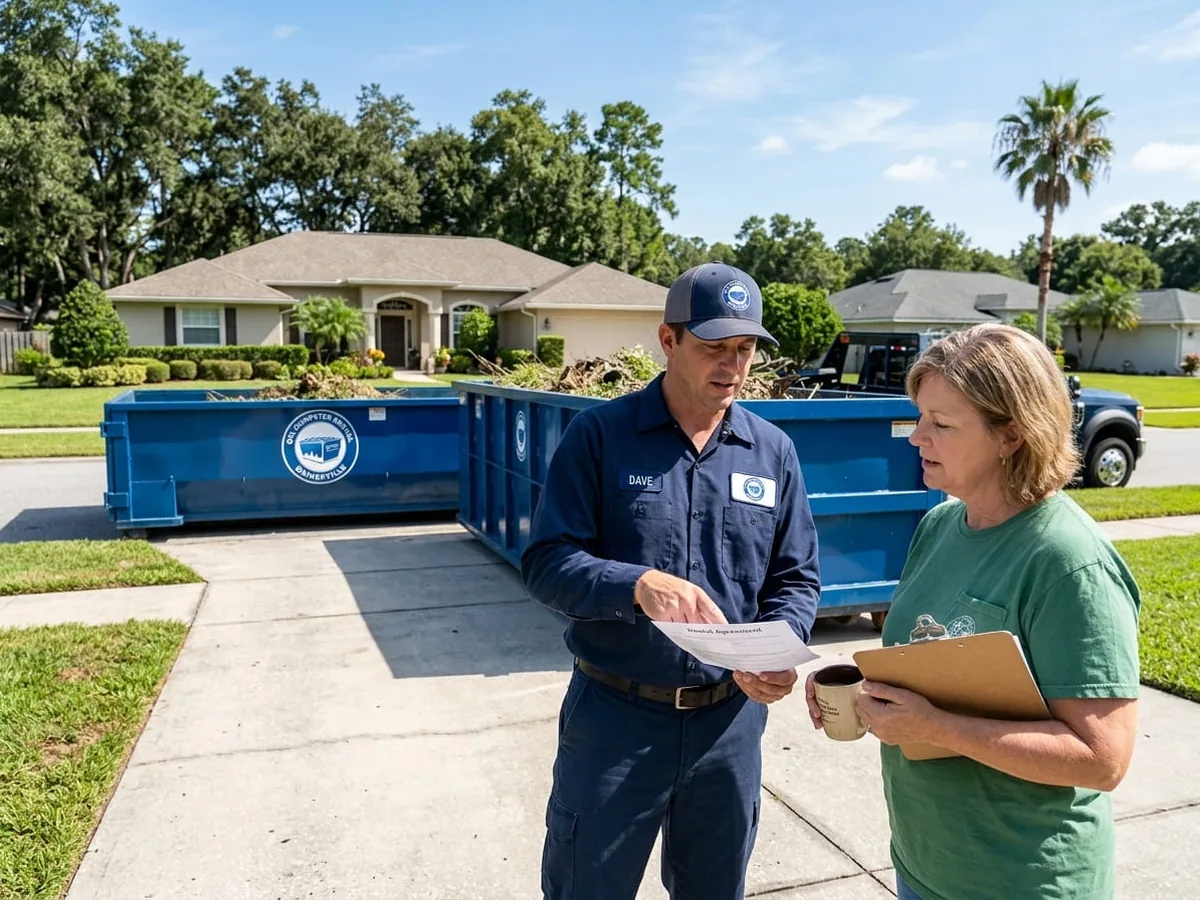
The question we get more than almost any other, once someone has picked a dumpster size, is some version of: "is this going to wreck my driveway?" It's a fair question. A loaded 20-yard roll-off with debris in it can weigh several tons, and it's riding on steel rails, not rubber tires, when it sits down. Done carelessly, that combination can crack a driveway, gouge asphalt, or rut a shell drive. Done right, it doesn't. Placement is a big part of what separates a delivery driver who's done this a thousand times from one who hasn't, and it's worth understanding before the truck ever backs up your street.
Gainesville makes this a genuinely mixed bag of a topic, because the driveways we place on aren't uniform. In-town neighborhoods like the Duckpond or the newer streets around Haile Plantation are mostly poured concrete or asphalt. Head out toward Archer, Micanopy, Waldo, LaCrosse or Windsor and you'll find a lot more shell and packed-gravel drives on acreage properties, plus some long dirt lanes back off the county road. Each surface behaves differently under a loaded container, and our drivers adjust the approach for each one.
Every delivery we do involves placing wood blocking — heavy timbers, sometimes plywood sheets over them for extra spread — directly under the steel rails of the container before it's set down. The rails are the only part of the dumpster that actually touches the ground, and they carry the full weight of the box plus everything in it, concentrated into two long, narrow strips. Without something underneath to spread that load out, those rails can dig a groove into asphalt on a hot Florida afternoon, or put hairline stress cracks into a slab that already had a weak spot from age or a prior expansion joint.
The blocking spreads the weight over a wider footprint and keeps the rails from ever sitting rail-to-driveway. It also does something people don't always think about: it protects the truck's hydraulic cable and the container's rollers from dragging directly across a rough surface as the box is set down and picked back up at the end of the rental. On a shell drive, blocking additionally keeps the rails from just sinking straight into loose material, which is its own problem — a container that settles unevenly is harder to load safely and harder to pull back onto the truck.
Poured concrete is generally the sturdiest surface we place on, but "sturdy" doesn't mean bulletproof. Older slabs, especially ones with existing cracks, control joints under stress, or a history of settling, can still be damaged by concentrated point-loading. Our drivers look for the flattest, most solid stretch of the driveway — usually not directly over a joint line — and always use blocking regardless of how solid the concrete looks. If a driveway already has visible cracking or a section that looks compromised, we'll talk through alternate placement (the street apron, if the city or county allows it, or a spot on the yard) rather than gambling with the existing damage.
Asphalt is more forgiving in cold weather and less forgiving in Florida summer heat, when it softens and becomes more prone to rail indentation. This is the surface where blocking earns its keep the most. We also try to avoid dropping or dragging a container across asphalt — the box gets set down in one placement and left there, rather than repositioned once it's on the ground, because sliding a loaded container even a foot can scuff or tear soft asphalt.
This is where Gainesville's outer towns are genuinely different from a lot of dumpster-rental content written for other cities. Shell, crushed limestone and packed gravel drives are common on the acreage lots around Archer, Micanopy, Waldo, Hawthorne, LaCrosse and Windsor, and out toward Melrose and the Levy County towns. These surfaces are actually pretty forgiving of point-loading in one sense — loose material won't crack — but they rut and shift, which creates a different problem: an unevenly settled container. Our drivers look for the most compacted, level stretch of drive, use wide blocking to keep the rails from digging in, and will often set the box a little closer to the road than a homeowner first expects, simply because that's usually the most stable ground on a gravel or shell surface. If your property has a long dirt lane rather than a true driveway, let us know when you book — we may place at the road-facing end rather than back near the house.
Sometimes there's no good driveway option — a driveway that's too narrow, already full, or under renovation itself. We can place on grass or a yard area in a lot of cases, but it comes with tradeoffs worth knowing up front: a loaded container will leave an impression in soft ground, especially after Florida's summer rains, and grass underneath won't survive a multi-week rental. We're upfront about that rather than pretending it's damage-free, and we'll use blocking there too, both for stability and to keep the box from sinking on wet ground.
Placement isn't only about what's under the container — it's also about what's above and around it on the way in. Roll-off trucks need roughly 14 feet of overhead clearance to maneuver a container into position, and Gainesville's canopy roads, while beautiful, mean low-hanging live oak limbs are a real consideration on some in-town streets and rural lanes alike. We also need a fairly straight, level shot to back the truck up — tight turns off narrow streets in older neighborhoods, low carports, or a driveway with a sharp grade change can all limit exactly where the container ends up. If you're not sure your property has a workable approach, tell us about the driveway width, any overhangs, and the general layout when you book, and we'll talk through where the box can realistically go before the truck ever shows up.
A few things on your end make placement smoother. Clear the intended spot of vehicles, trash cans, potted plants, and anything else in the way. If you have a preference for exactly where on the driveway the container sits — closer to the garage, or further down toward the street — mention it up front, since repositioning after delivery isn't something we do casually. And if your property has an unusual driveway situation — a steep slope, a shared drive with a neighbor, a gate, or a shell lane that hasn't been graded in a while — a quick heads-up when you book lets us send a driver who already knows what to expect instead of improvising on arrival.
Talk to a real person
Call (352) 900-1538 and describe the job. Flat price, stated tonnage allowance, and a delivery window on the same call.
Mon–Sat 7:00am – 7:00pm
From this guide
Not when it's placed correctly. We use wood blocking under the steel rails on every delivery, which spreads the container's weight out instead of concentrating it in two narrow strips. Older or already-cracked slabs need extra care, and we'll talk through alternate placement if a driveway looks compromised.
Yes — shell and gravel drives are common on the acreage properties around towns like Archer, Micanopy and Waldo, and we place on them regularly. We look for the most compacted, level stretch and use wide blocking to keep the rails from rutting the surface.
Roughly 14 feet of overhead clearance to maneuver the container into place, plus a reasonably straight, level approach to back the truck up. Low-hanging limbs on some of Gainesville's canopy streets can be a factor, so let us know if your access looks tight.
In many cases, yes. It's a reasonable option when the driveway isn't available, but a loaded container will leave an impression in soft or wet ground and the grass underneath usually won't survive a multi-week rental. We'll still use blocking for stability.
We try to get placement right the first time rather than dragging a loaded container across your driveway, which can scuff or tear the surface. If you have a placement preference, tell us before delivery so our driver can plan for it.
Keep reading
How to size a dumpster to your actual renovation scope, sort mixed-material debris efficiently, and figure out what's worth recycling versus hauling off.
ReadHow to time and place a dumpster around Gainesville's real May and August student-housing turnover — what typically gets left behind and how to handle tight near-campus lots.
ReadDumpster pricing in Gainesville isn't one flat number; it moves with size, weight, distance, and rental length. Here's what actually drives the cost of a roll-off in the Gainesville area.
Read